Honouring Time, Making Space: Finding Balance In Artist Representation
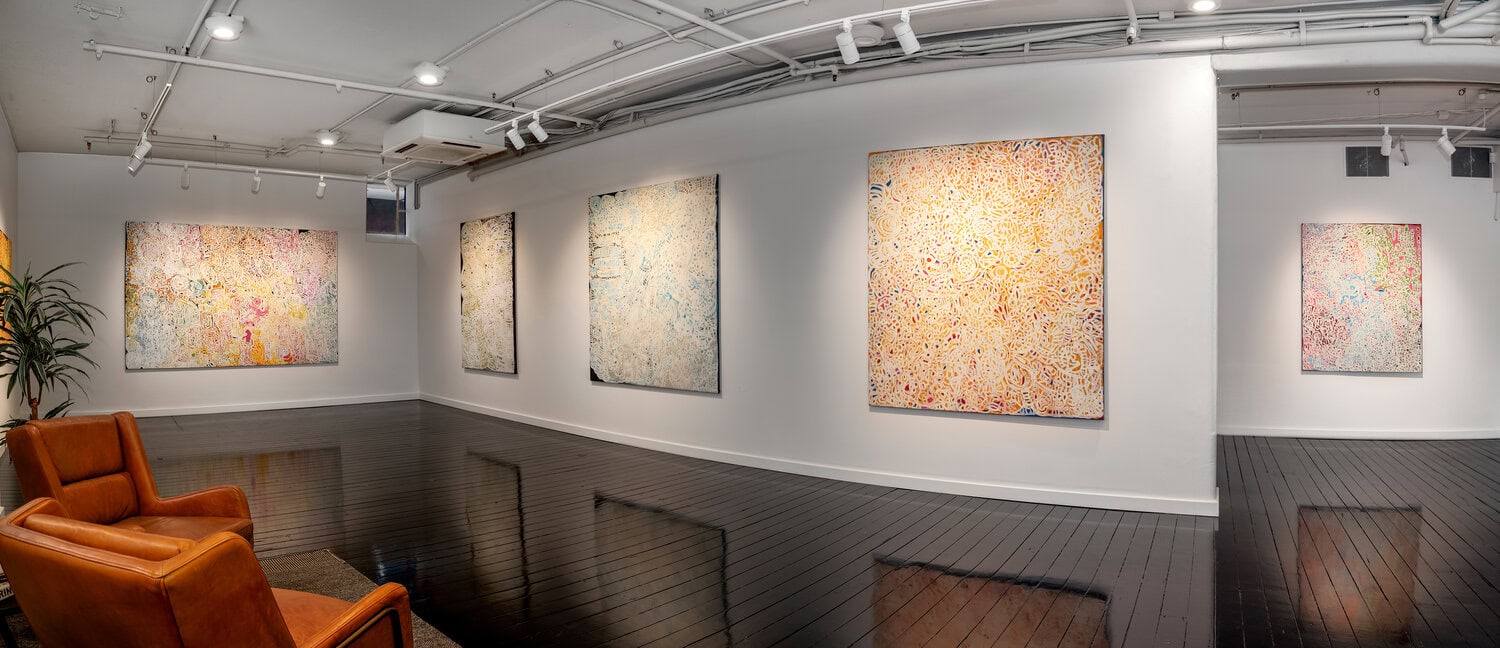
Minyintiri: Life in Layered Time installation view at D’Lan Contemporary, Melbourne
Yindyamarra is a word from the Wiradjuri people in New South Wales which means: ‘to be gentle and care, which expands to respect, give honour, go slow and take responsibility’.[1]
I discovered this term while listening to artist and scholar Brook Garru Andrew speak about his curatorial approach to the 22nd Biennale of Sydney in 2020. As the artistic director, Brook named the ground-breaking First Nations and artist-led exhibition, NIRIN, meaning edge in the Wiradjuri language of western New South Wales. Brook led with the duty of care to its collaborators, which extended from an acute awareness and innate understanding of the responsibility to cultural protocol. Honouring yindyamarra is a methodological approach to curating global First Nations exhibitions.
For Brooke, curating is a form of sovereignty and ceremony. Going ‘slow‘ allows for the pace to be set by cultural rules of conduct. It requires the whole picture to unfold for greater understanding and respect to the artists, their work, and its obligation and contribution to Indigenous cultural knowledge systems.
Standing alongside the practice of Indigenous Curatorship is the non-Indigenous curated exhibition. This is the standard practice within the primary Indigenous Australian art market, where it is usually the non-Indigenous gallerists and art centre managers who deliver these exhibitions. In this instance, it is expected and generally understood that lacking the ingrained, generational knowledge and understanding of cultural protocols, gallerists host exhibitions from a position of cultural neutrality. Although the artworks created for this space are intended to sell, the work maintains its living connection to culture and, in many cases, its form of ceremonial practice. The gallerists who are deciding the future of the artists are obliged to hold open a space that allows the represented artists, their artworks, and most importantly, their culture to speak for themselves.
Enduring successful relationships have been built from the appreciation and respect between these parties that cannot be disregarded. However, the future of artist representation may lie in the delicate balance between the fast-paced expectations of the market and embracing the more sensitive principles of yindyamarra.
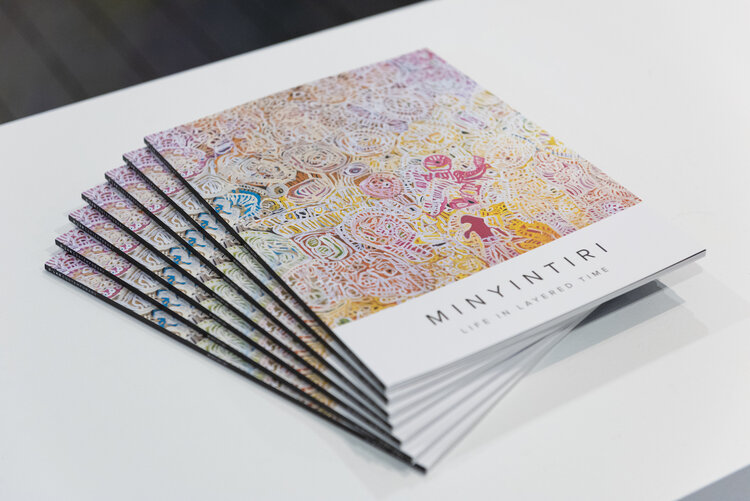
Minyintiri: Life in Layered Time exhibition catalogue
As the closing week of Minyintiri: Life in Layered Time approaches, there is an opportunity to reflect on the representation of artists, with the career of Dickie Minyintiri as a case in point. Dickie started painting very late in life and only produced a relatively small number of works in nine years, which is the main reason that he never had a solo show in his lifetime. Only now, seven years after his passing, was a significant body of his work exhibited in one place. The fact that only a handful of people outside of Ernabella knew of Dickie Minyintiri – a senior lawman, revered ngangkari and important APY artist – is a prime example of how the constant demands of the market can silence the opportunity to build an enduring legacy for a significant artist.
Although we can appreciate his work by curating a survey exhibition retrospectively, the question remains: would his status have secured longevity if markets were allowed to go slow and practice the sensitivity required to build a following that echoed his prominence in his community of Ernabella? Slowing down may give way for a deep listening that allows for more non-Indigenous people to connect with the nuances of Indigenous Australian culture and its major communicators.
Although this Wiradjuri concept is not ours to adopt or claim as a simple mission statement, we can learn from an understanding of its approach.
Can we, as an industry, shift the way we operate to make for a more sustainable future for Indigenous Australian Arts?
Can markets ‘afford’ to adhere to the notion of yindyamarra? Suppose primary galleries slow their methodologies and processes to give honour and take responsibility. Would artists’ career trajectories be more carefully nurtured and handled?
One solution could be in taking a more measured approach to building and creating exhibitions that develop national and international interest in artist careers across a long time scale. Another, possible under certain market conditions, is in the development of the means to host exhibitions such as Minyintiri, a unique non-selling show that was internationally promoted and renewed interest in his output.
As we move to close Life in Layered Time, a belated although not insignificant contribution to Dickie’s legacy, we can aspire to represent practising artists in a way that values the gift of time – to give honour, go slow and take responsibility to make space for the artist’s and indeed the culture’s voices to be heard.
Curator, Vanessa Merlino
[1] Brooke Garru Andrew, Indigenous Curation, ACT Spring 2021 Lecture series, MIT Webcast