On the Archer River with Janet Koongotema
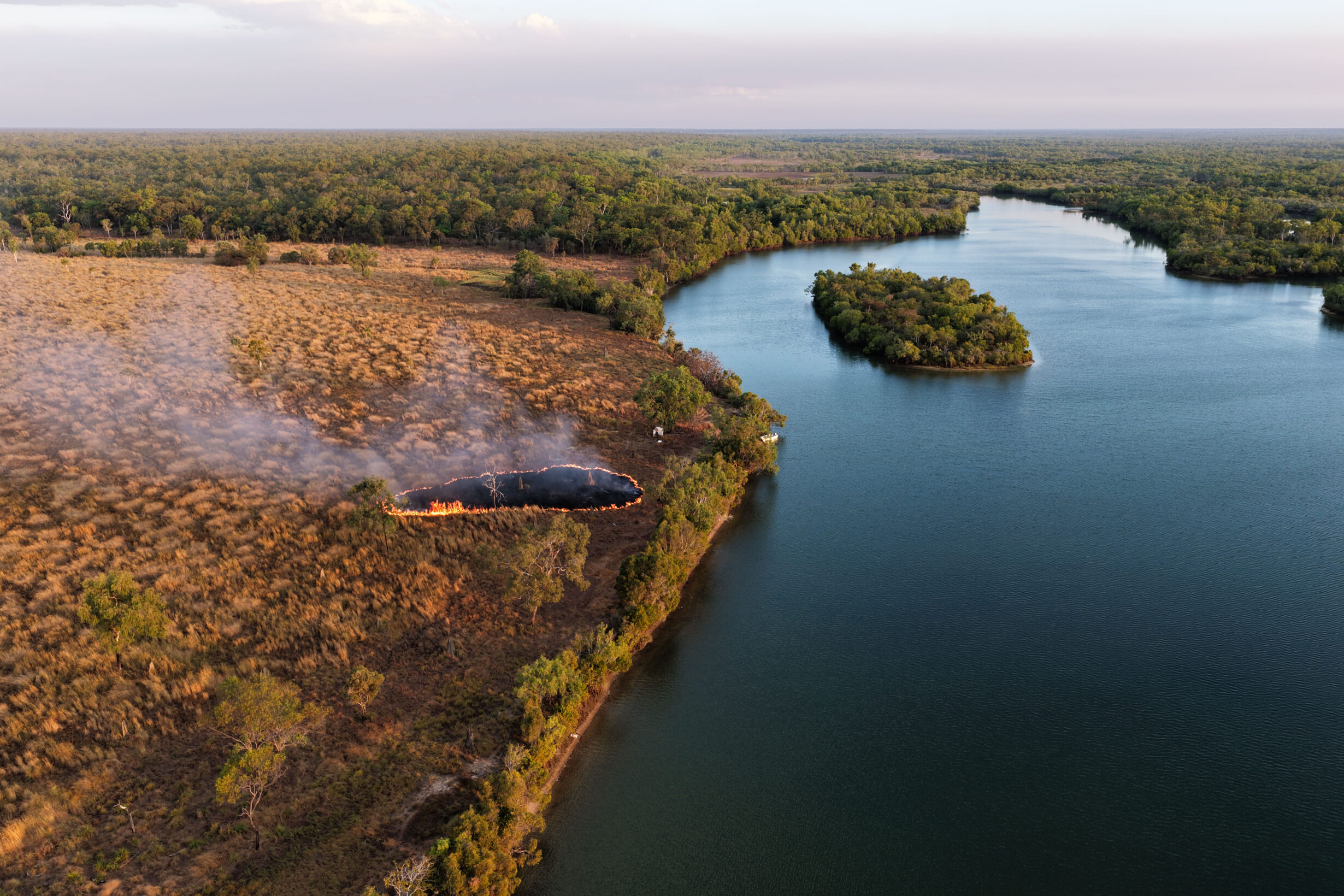
Flying in from Cairns, the landscape shifts from green coastal ranges facing the Coral Sea to the vast, dry expanse of North-Western Cape York Peninsula, where huge termite mounds rise like sentinels from the red earth and snaking, silver rivers thread through paperbark swamps. The community of Aurukun feels like it sits at the edge of everything. It lies at the mouth of the Archer, Watson and Ward rivers, which flow into the large, shallow sea of the Gulf of Carpentaria. It is August, the heart of the dry season, and the climate is comfortable, with no rush towards the humidity that precedes the rain.
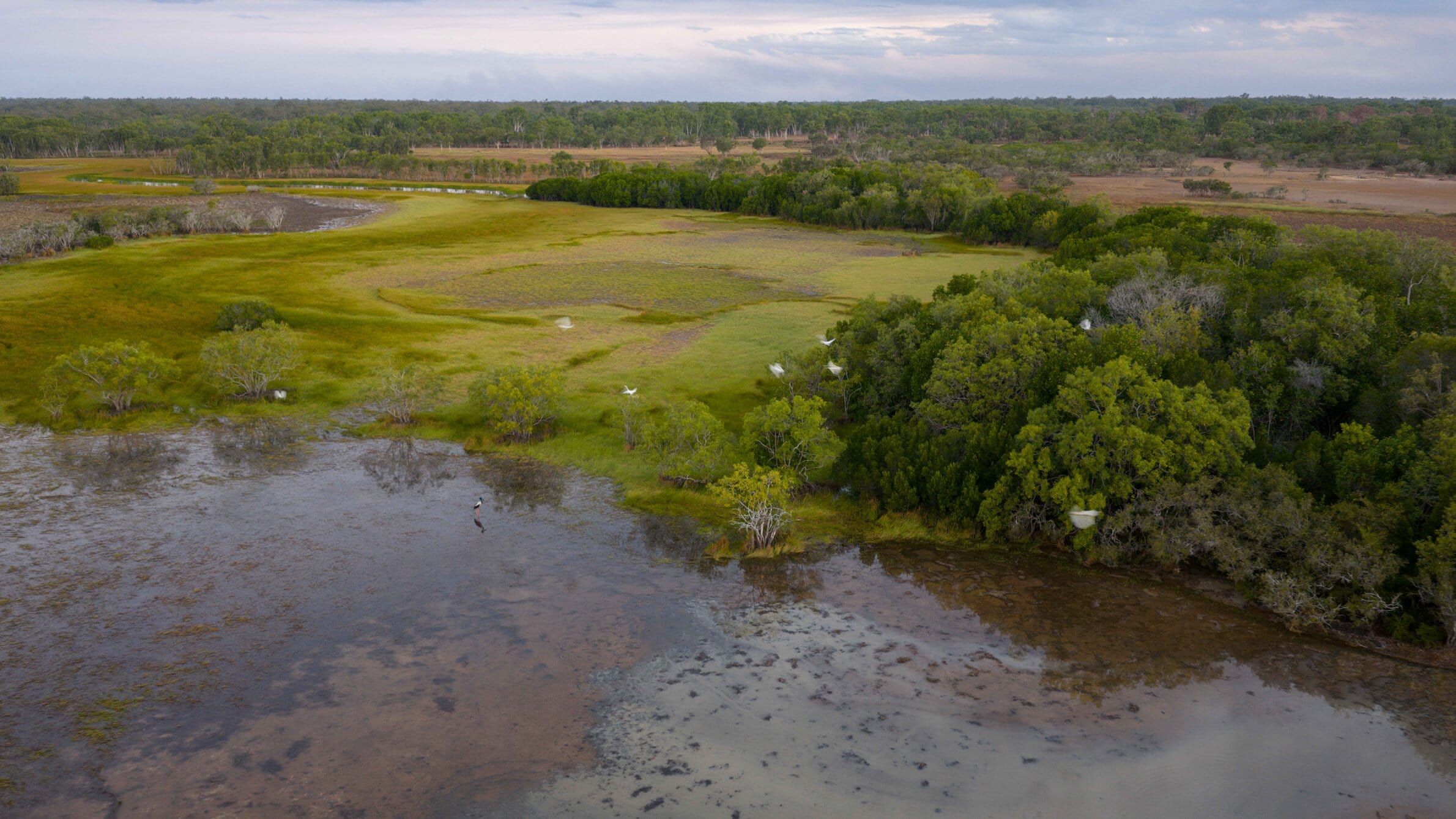
Archer River Country | Photograph: Gus Davidson
The Wik & Kugu Art Centre is located near the centre of the community and supports artists from the five Ceremonial Clan groups living at Aurukun – Apalech, Winchanam, Wanam, Puch and Sara. The building is predominantly a large workshop designed to support the men’s sculptural practice, which involves harvesting, sanding and carving locally sourced milkwood or milky pine, the majority of the artwork produced here. Currently, it is a space occupied by men – both artists and artworkers, tools and wood in various states of completion – ranging from raw cut-offs to ochre-painted animals coming alive with the finishing touches to their eyes.
This is where we first meet Janet Koongotema, whose exceptionalism is only emphasised in this environment. As an 87-year-old Wik-Mungkan woman of the Winchanam clan, Janet is an elder not only culturally but also demographically. In a community of around 1,200 people with a median age of 28, Janet is by far the oldest resident. She is also the only woman regularly practising at the art centre and the only artist working exclusively with acrylic paint on linen canvas. Despite her age and deceptively slight figure, Janet is irrepressible, crossing the community alone every day, pushing her walker to come and work at the art centre. She greets us warmly in a mix of refined English and Wik-Mungkan, one of Australia’s strongest remaining Aboriginal languages, spoken by fewer than a thousand people.
We have come to travel with Janet to her Country on the Archer River, the source of her artistic vision and the places that live in her paintings.
We set out the next afternoon: Janet, Wik & Kugu art centre manager, Gabe Waterman; his dad and boat driver, Noel; our translator Perry Yunkaporta; Gus our videographer; and me. The boat burns up the Archer River, its banks dense with pandanus and paperbarks. I am acutely, hyper-aware of the crocodiles. Just earlier, Janet had earnestly and persistently warned me about the dangers, and we see them shifting on the banks as we pass. Only six months ago, she told me, a 60-year-old man from Aurukun had been taken while fishing at the junction of the three rivers, an area we would pass on our journey. I try not to have a full-blown panic attack.
But the river is also teeming with less intimidating life, the totems that feature in Janet’s paintings. Flocks of Burdekin ducks feed in the shallows, and an eagle circles overhead, as if following the boat. The Kang-Kang/White-breasted Sea Eagle is Janet’s main totem, and she raises a finger to the sky in recognition. This is her Country, and she keeps pace with its rhythms.
We pull up along the river at the centre of Janet’s Country. As we step out of the boat, she welcomes us here in Wik-Mungkan and begins naming the places around us. Here is where she camped as a young woman. There is a fishing spot her family has used for generations. Further upstream are more story places she knows and paints. We stop so Janet can burn Country. She walks to a section of dry grassland where a huge termite mound towers at the centre, like the ruins of an ancient castle. She throws a match, and the grass is set alight. The sound is extraordinary. As the flames take hold, the crackling builds to a roar, and the mud structure is besieged by smoke, then by the softer hiss of grass turning to ash. The fire is not destruction but care; it clears the undergrowth, encourages new growth, and maintains the balance that sustains this land. Janet watches the flames with quiet satisfaction.
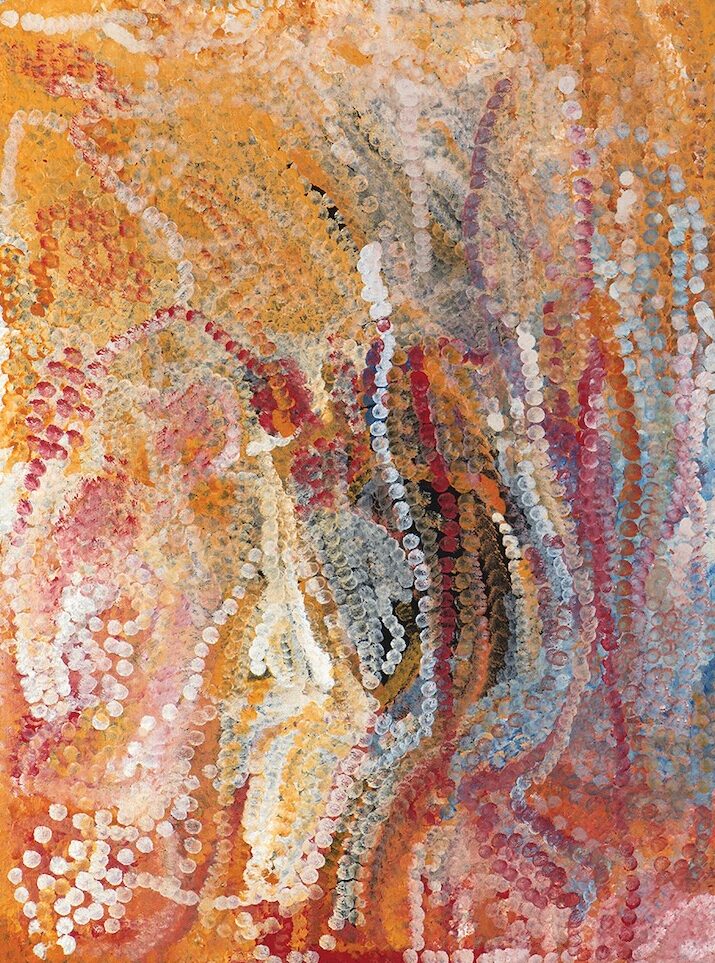
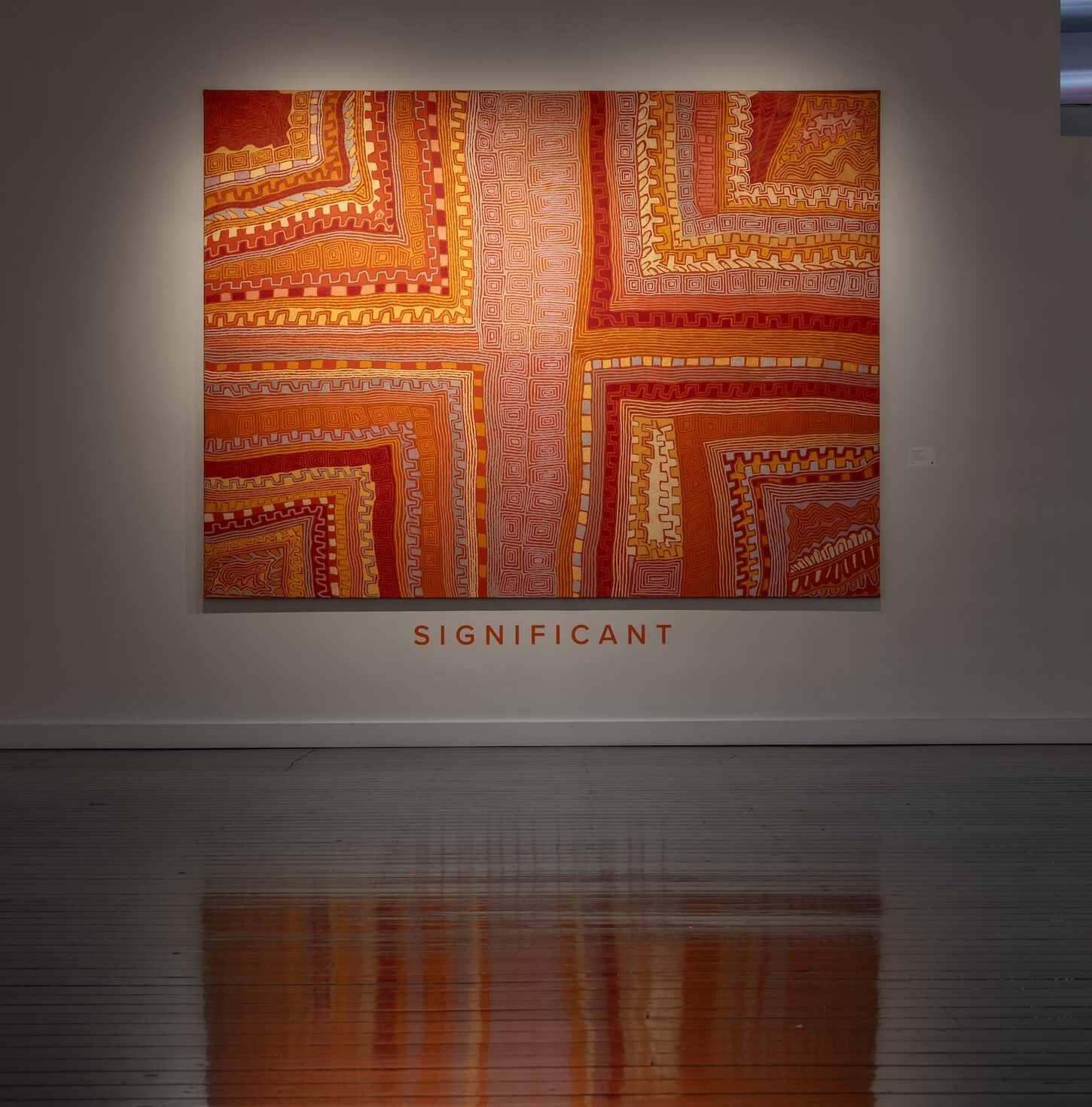
Back at the art centre the following day, I watch Janet paint. She works at a table, seated on her walker, outside if there is a breeze or inside if the heat is too oppressive. Her canvas lies flat, and she builds up horizontal bands of colour, working from the outside inwards. Colours are layered on top of one another, the same colours I had seen in the water, the sky, the burnt grass, and on the riverbanks of the Archer River.
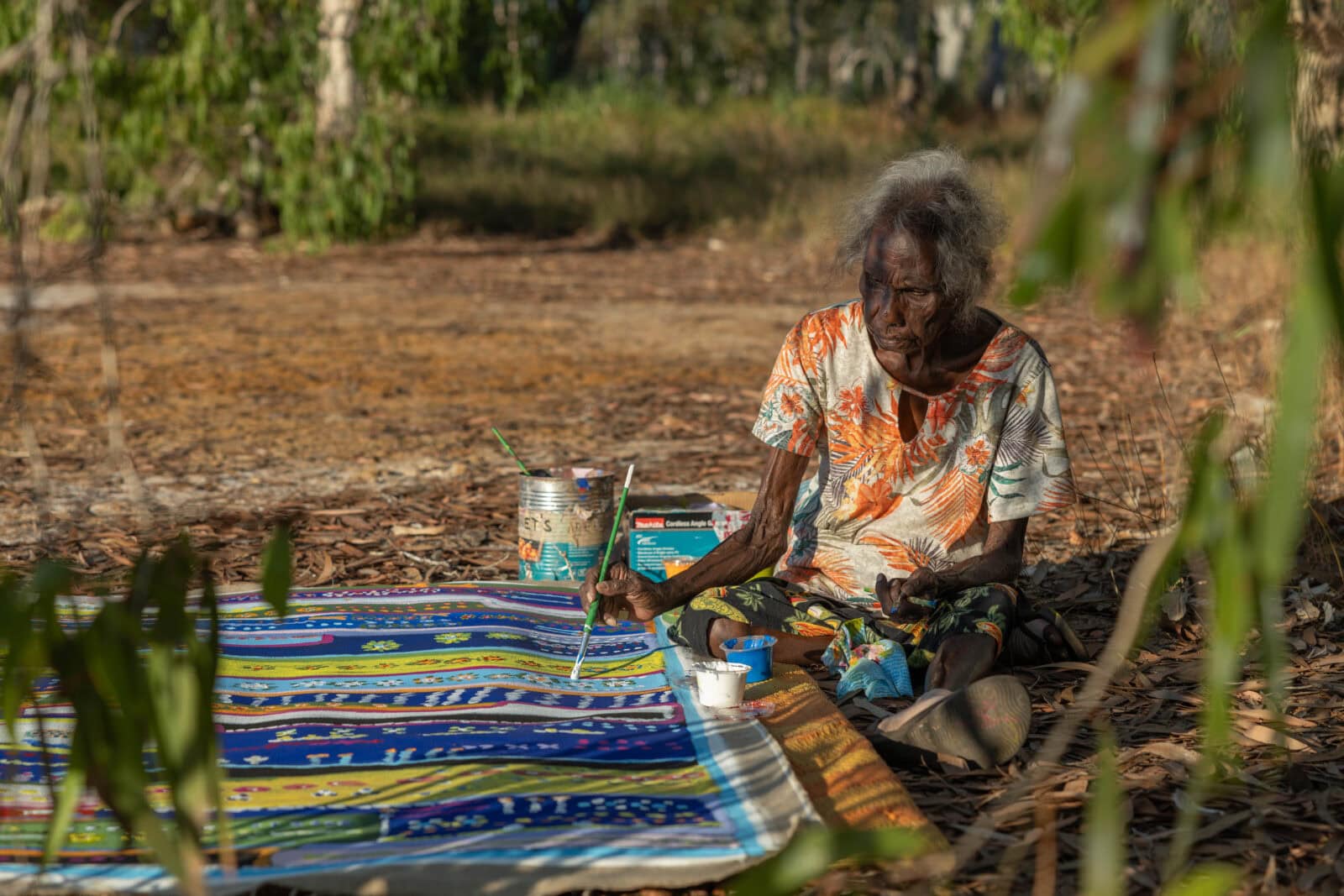
Janet Koongotema painting on Country | Photograph: Gus Davidson
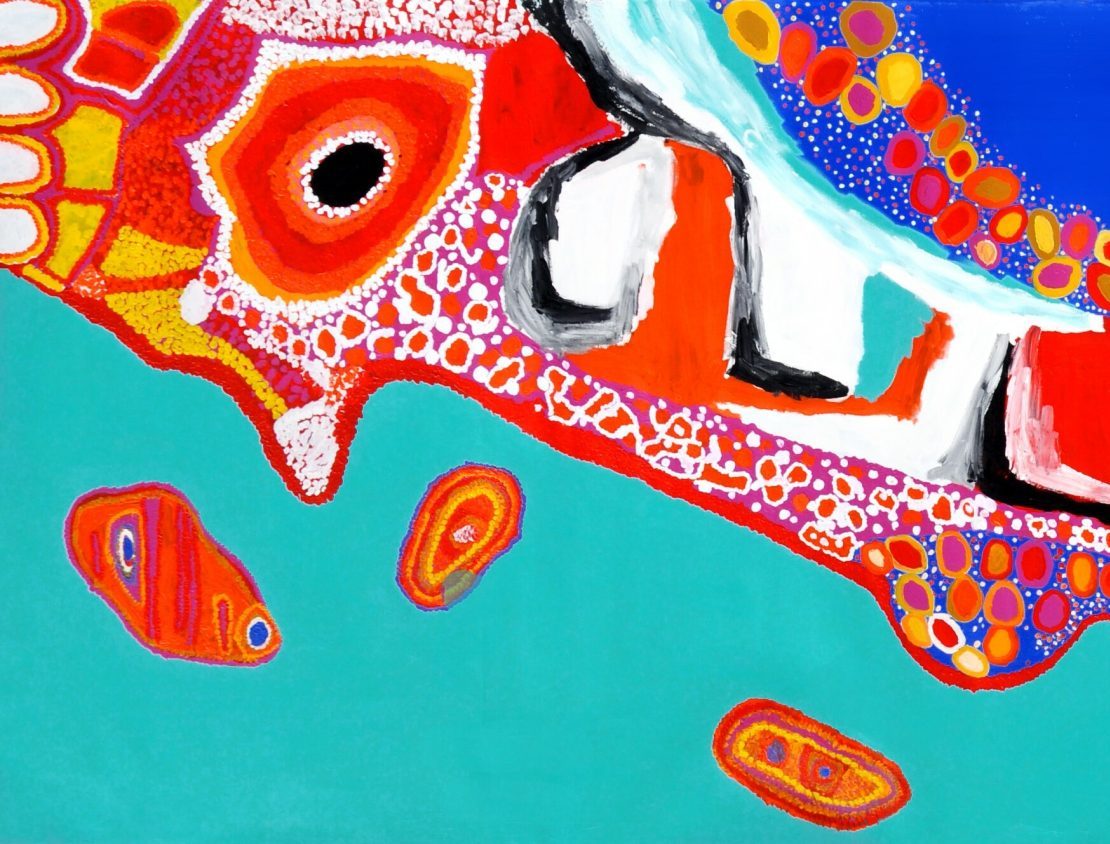
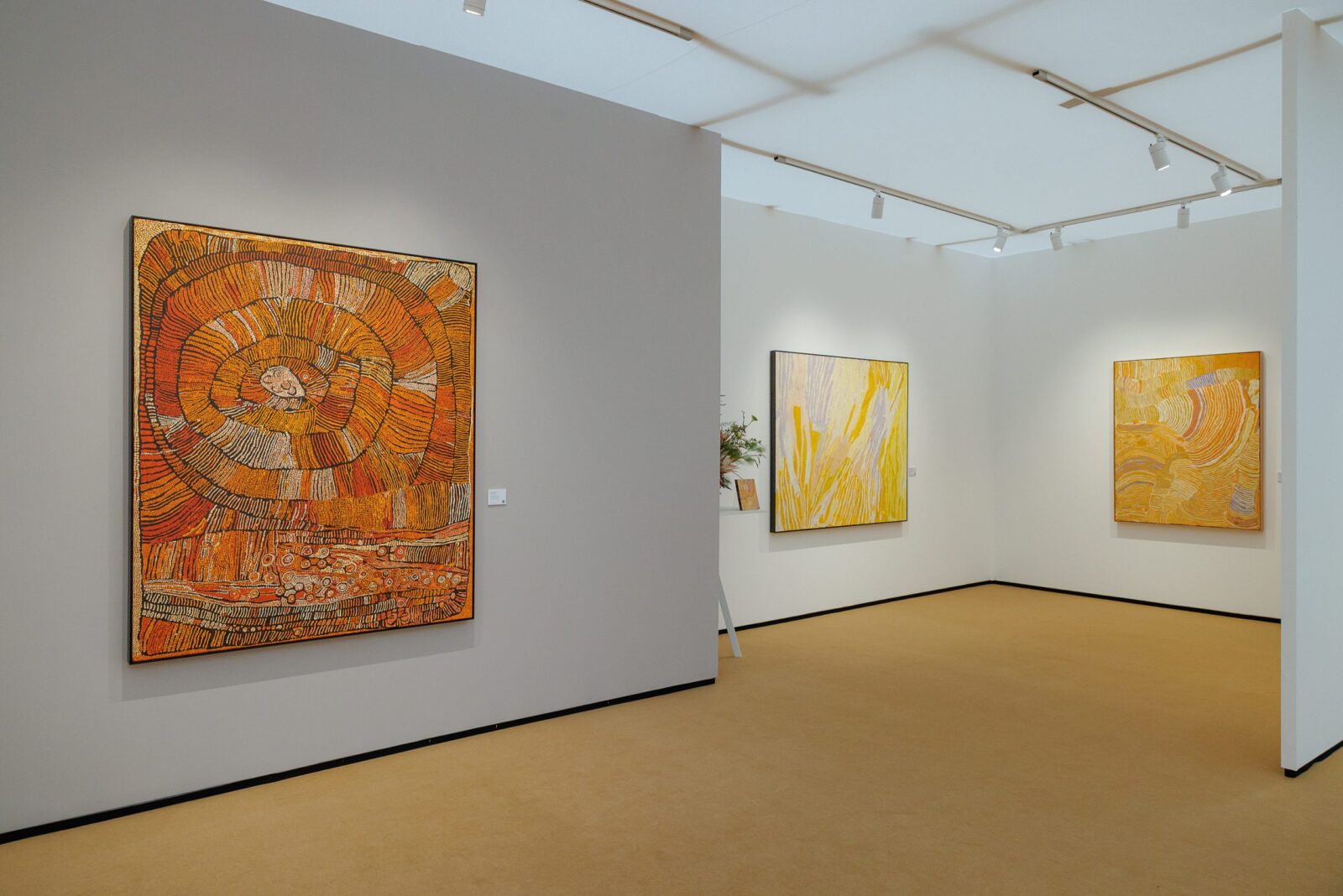
Janet was a weaver long before she began painting in 2010. For years, she made dilly bags and pandanus bowls, fibre vessels built up in horizontal rows. When she turned to canvas, however, the structure remained. Her paintings are weavings translated: the same horizontal logic, the same patient accumulation, the same mapping of place.
Watching her work, I begin to understand what I had seen on the river. Janet’s paintings are not representations of landscape; they are the landscape, compressed and encoded. Each band holds the belonging of homelands; its embodied ‘Aw, memories of lived experience, a way of being on Country, and their places in time, both ancestral and historic, weave them together.