The Legacy of Paddy Bedford
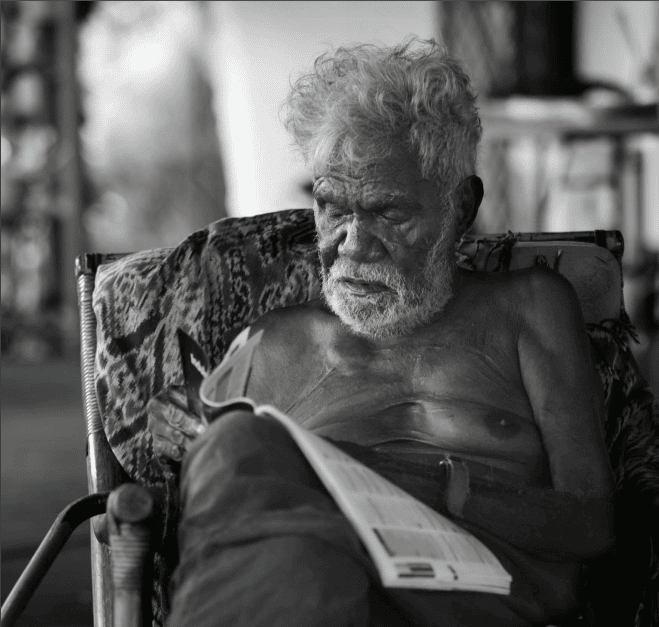
As with many senior First Nations culture keepers who turn to painting, Goowoomji Nyunkuny Paddy Bedford’s deep cultural knowledge was a strong impetus for his late-life painting practice. He started painting for traditional ceremony at an early age and gained a deep respect for customary law through this practice. He conservatively observed its restrictions throughout his painting career, creating a visual language that brought East Kimberley painting to the world, without compromising traditional Gija conventions.
Paddy Bedford bestrode the gulf between black and white nations by applying his laws. Goowoomji asserted Gija terrain with dignity and authority, set a precedent for financial liberation and was an arbiter for brutal truths. In the 1970s, he took part in new forms of cultural assertion, playing an active role in ceremony during a period of creative and cultural turbulence in the Kimberley. Joining Jirrawun Arts in 1998, he was a catalyst for the formation of a vision by a small group of Gija Elders to control their identity and create unique visual art forms without compromising cultural law and tradition.
In 2004, at the Victorian Registry at the Federal Court of Australia, Paddy Bedford addressed the senior judges present with an introduction as poignant as it was formidable: Hello ladies and gentlemen. My name is Paddy Bedford. I know black fella law. I know white fella law. I am the Law.
To those who witnessed this event, it was a compelling assertion of his personification of Law in the presence of white law personified.1
Unintimidated but not irreverent, Paddy Bedford, the artist and lawman, extended his hand to those he saw as equals in their obligation to the legal systems and practices that steer the destinies of people. Like the men and women before him, Paddy Bedford was an embodiment of Law–traditional, cultural and spiritual, which was lived rather than written. His mandate, however, set him apart from the senior judges in his presence, for his life, like his paintings, involved seeking to rebalance cultural obligation and agency against the violent and disruptive history of settler encroachments on his land.
Paddy Bedford, known to family and kin as Nyunkuny or Goowoomji in his own Gija language, was born around 1922 at Old Bedford Downs Station, south-east of Warmun (Turkey Creek) in the East Kimberley region of Western Australia. The pastoralists who colonised this area of Gija Country gave it the name ‘Bedford’ in the late 19th century. Some years before Nyunkuny’s birth, Bedford Downs had been the site of a massacre of Gija people ordered by the station manager. A number of the artist’s relatives were poisoned with strychnine in retaliation for killing a cow, and their bodies were subsequently burned.
The station manager, Paddy Quilty, who was responsible for giving the order for the massacre, gave Nyunkuny’s Western name, ‘Paddy’, to him at the time of birth. This act reflects the disaffecting conditions in which Bedford’s family lived, which is how most First Nations Australian people experienced life in the region, known to white settlers at this time as the ‘last frontier’. Although not the only massacre to have occurred in the region, this particular event has had its memory kept alive by the Gija people and was a significant subject in Paddy Bedford’s art.
In 2000, Paddy Bedford, together with fellow artist Timmy Timms revealed the existence of a Joonba, a traditional song and dance cycle that told the story of the Bedford Downs massacre to outsiders for the first time. More explicit than his paintings, though equally commanding, the public performance of the Joonba demanded reconciliation on occupied lands, a demand that, to this day, resonates within Bedford’s painted canvases.
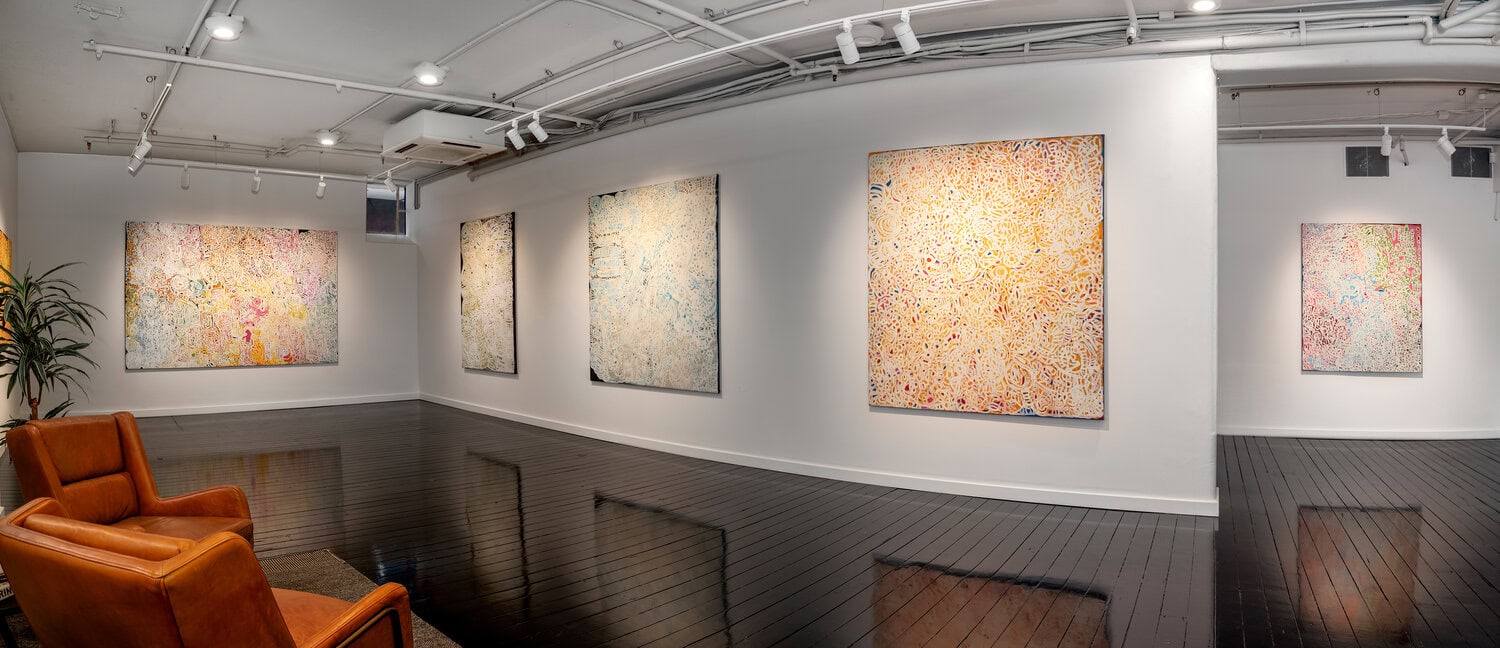
Bedford’s perfectly balanced paintings are rich with multifaceted and intricate layers that also transcend the brutalities of colonial history. He paints places from his mother and father’s traditional lands that are of great significance in Gija Country through their connection to the Ngarranggarni – in the Gija language of the East Kimberley – the Dreaming and its narratives. They encapture landscape features, the deeds of the ancestral beings during the ever-present dimension of the Ngarranggarni – and the superimposed and overlapping histories of the mortal and recent past.
Barlooban, or Motor Car Yard, is one of the most important ancestral sites Paddy Bedford painted. The English name for the place relates to the abandonment, long ago, of an old car there. The outstanding feature of Barlooban is a small flat rock that stands high up on a hill. This is the manifestation of Wawooleny, the frill-necked or blanket lizard. In ancestral times, Barlooban was home to both Wawooleny and Girrganyji, the brown falcon who stole the fire and the food of Wawooleny as he sat cooking to keep himself warm. The two men fought, but Girrganyji took off and set fire to the land, leaving Wawooleny to transform into the rock, forever contemplating his loss.
The figure rising from the bottom left-hand side of Blanket Lizard – Motor Car Yard 2004 is an unusual representation of Wawooleny. In other paintings that depict this site, Paddy Bedford usually represents him as a rounded form hovering or just touching the black ground. Here, he is suspended, drawn upwards by the surrounding halo within the composition. The vertical landscape is the focus of his gaze in lament for the battle lost.
Although drawing on the ancestral past, and renewing its present, Paddy Bedford’s paintings were not direct invocations of the Ngarranggarni. Instead, the Ngarranggarni was the living narrative that guided his hand to paint without hesitation, powering his abstract forms. Two other 2004 paintings, Thoowoonggoonarrin and Dingo Spring, are meditations on two important ancestral sites, their open compositions nonetheless inviting engagement. Thoowoonggoonarrin is a Dreaming place for a large tree with dark leaves that is related to a fig tree. It is also a place of emotional significance for the artist, as his mother’s sister died in this Country. Dingo Springs is a Dreaming place for the marranyji, dingo. The Gija name Manjalngarriny refers to a kind of white stone that was used for making artefacts. Bedford evokes this narrative through the luminosity or transparency of his paint, achieved through his wet-on-wet technique, which requires a fast method of application. This became a characteristic of his paintings made after 2004, most likely as a result of Bedford working consistently in gouache as a fluid and spontaneous practice alongside his larger paintings on canvas.2
Not only did Paddy Bedford embody the eternal presence of the Ngarranggarni, but also the changes and developments necessary to help his people live alongside white man’s law. His faith and hope in ‘two way’, the Gija expression for reconciliation, was a magnetic force that engaged those around him in helping create the support structures that would protect and preserve his legacy. What he stood for – his people, history and culture – he attested in his exquisite abstract paintings. The impeccably balanced compositions of his mother’s and father’s Country, felt far beyond his homeland, became the most potent vehicle for advocating reconciliation. The innovation and experimentation that was fundamental to his practice as a contemporary artist and the meticulous way in which his estate was designed would assure the efficacy of his advocacy.
For Goowoomji was ‘the Law’, and in considering the faceted meanings he conveyed, one can better understand his life and work. The trust, self-discipline and strategic foresight involved in the meticulous orchestration of his legacy through his estate facilitated his preservation of Law, and allowed him to gain control of his future, including a future that extends beyond his own life. His descendants will be assisted in their European-based schooling due to the education trust established through funds derived from the proceeds of sales at exhibitions of works from his estate.
As we come to the close of the Estate of Paddy Bedford, seventeen years after his passing, the final release of his paintings and gouaches offers the opportunity to reflect on his work today and the way it maintains its contemporaneity. His sense of innovation and experimentation, applied within the obligations of Gija law and tradition, sets Paddy Bedford among the greatest Australian First Nations artists. It is unlikely that we will ever see another person or artist like Goowoomji Nyunkuny Paddy Bedford.
VANESSA MERLINO
—
1. As witnessed and related by Peter Seidel, Co-executor, Estate
of Paddy Bedford, and Partner, Public Interest Law, Arnold
Bloch Leibler.
2. Georges Petitjean, ‘In his Dreams’ in Bonhams Magazine,
issue 29, Winter 2011, p. 14.