WOMEN AT DELMORE: Emily Kame Kngwarreye And Janet Holt
Much can be said about the significance of intercultural partnerships that mark contemporary Indigenous Australian art history. When suitable cultural brokers have been employed and ideal conditions set, artists have not only traversed the cultural divide but forged a distinct and permanent impression on the trajectory of contemporary Australian art.
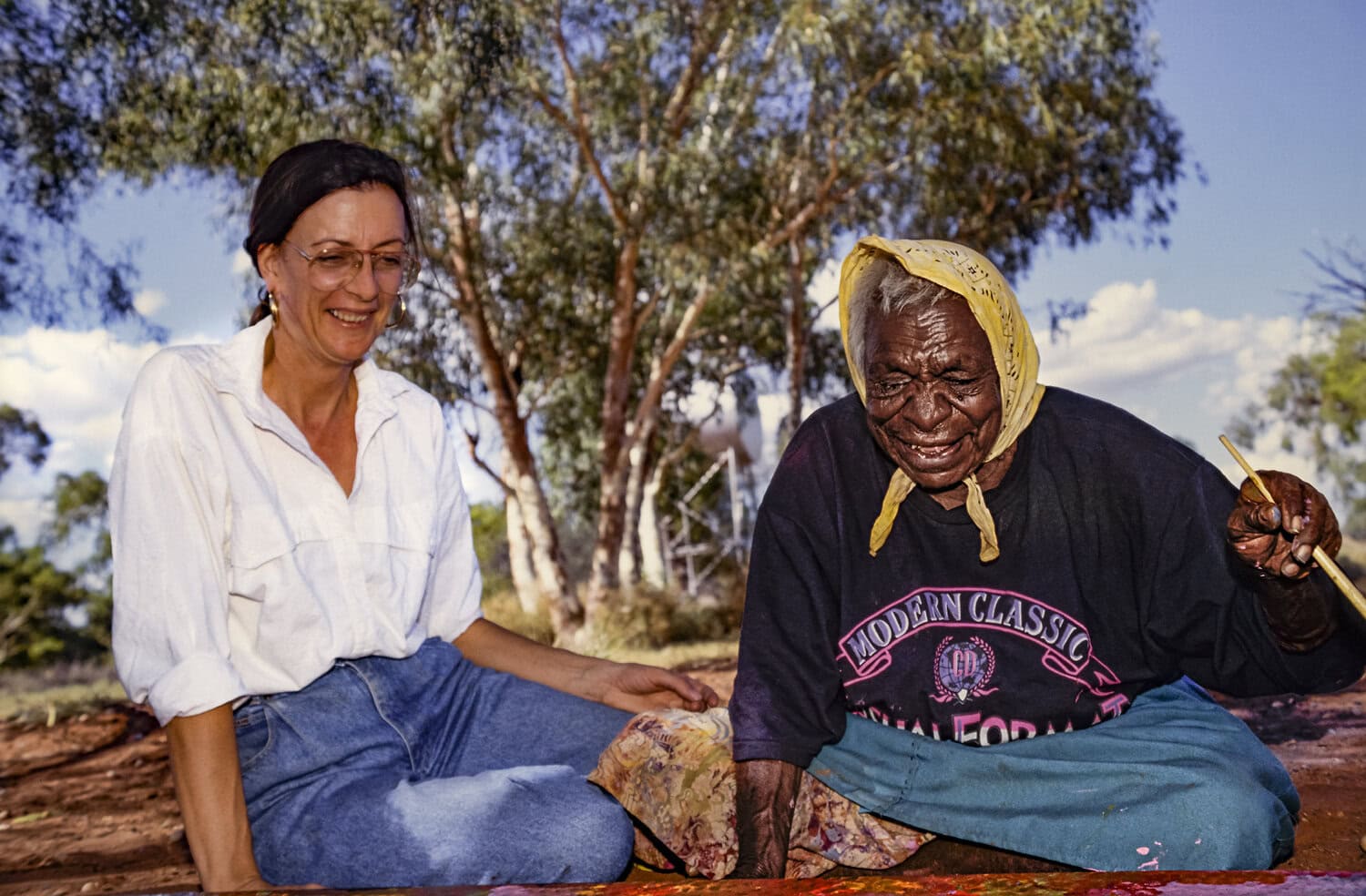
Indigenous Australian art was founded on this kind of cross-cultural collaboration. The best working relationships have nurtured creative and individual expressions and assist artists in achieving iconic status and success. No one is more celebrated in Australia’s art history than Anmatyerre artist Emily Kame Kngwarreye. The relationship between Emily and Janet Holt of Delmore Downs that grew between 1989 and 1996 was one of care and respect and set the tone for Emily’s most significant explorations of awelye – women’s ceremony in her paintings.
Janet Holt, then Janet Wilson, first came to Alice Springs in the Northern Territory and the prospect of managing aboriginal artists when she took over running the newly established enterprise Papunya Tula Artists from then advisor Peter Fannin in 1975. Janet travelled between Papunya, Yai Yai and Brown’s Bore on Haast Bluff to deliver art materials and purchase works for the company. All the great Papunya Tula Artists were painting during these early stages of the outstation movement. As no women were painting for themselves at this time, the expectation was to engage with the men in art business matters and keep within the gender parameters of which Janet honoured for just over two years.
Janet met and married Donald Holt and moved to his family’s property of Delmore Downs cattle station in Utopia, Northern Territory, in 1977. It was not until then that the experience acquired at Papunya Tula was applied to a new chapter, not only for Janet but in the broader story of Indigenous Australian art. As the station sat on the overlapping country of Alyawarre, eastern Anmatyerre and eastern Arrernte language groups, the Holt family had historical ties with the people living in this region of Utopia, particularly Emily Kame Kngwarreye and her family. However, the confluence of Janet and Emily at Delmore created a unique atmosphere for Emily’s expression to evolve.
Emily’s talents as an outstanding individual artist were recognised and nurtured by principal dealers Rodney Gooch, Christopher Hodges and Donald Holt. However, the women surrounding and supporting Emily may take credit for creating the working atmosphere that would produce the masterpieces of her opus. Emily’s adopted sister Lily Kngwarreye rarely left her side and was acutely attuned to her needs. However, Janet can be appreciated as the familial presence in which Emily also found equanimity. At Delmore, Emily and Janet were engaged in a symbiotic nurturing relationship. Janet would ‘look after’ Emily, attending to her health, comfort and studio needs to allow Emily to attend to her family and nurture the spiritual and environmental needs of her cultural obligations
Janet Holt & Emily Kame Kngwarreye at Delmore Downs. image: Steve Strike
Emily’s authority, her all-embracing and nurturing feeling of all things ceremonial, could be safely held at Delmore. Although not always present in every painting, her yam tracking lines are the connecting element to awelye, which, when performed, releases the spiritual power that maintains nature’s fertility and hardiness. On the property of Delmore Downs, Emily led the Utopia women to perform awelye for Alhalkere on three occasions. Although never a participant, Janet witnessed Emily’s ultimate authority in these ceremonies. She watched as her body was cleansed in preparation and applied paint to the breasts and arms by firelight at dusk. However, most significantly, Janet witnessed Emily’s strength in ceremonial performance, bringing structure and order to both nature and society for their survival.
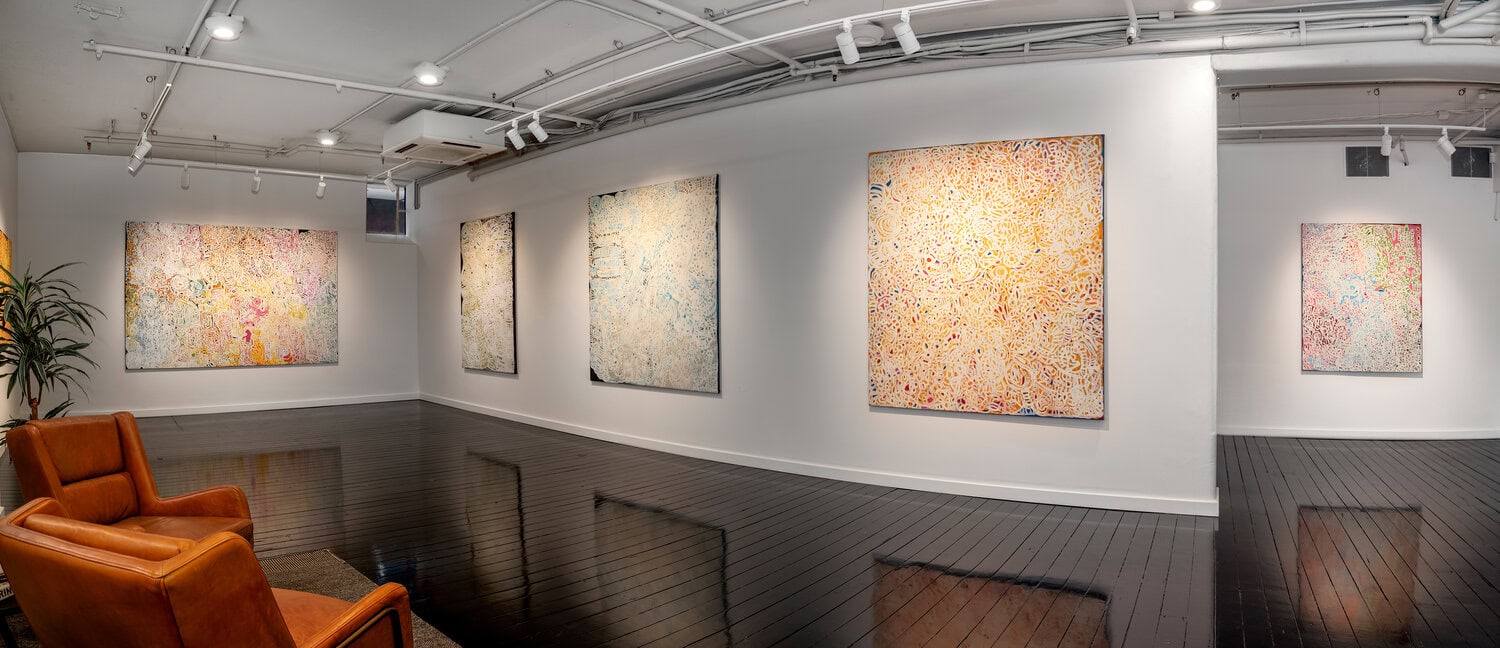
Desert Ceremony I painted in 1994 captures the sensuousness and effect of awelye. The canvas becomes skin, which then becomes earth, and is reverently marked with paint through the strength of Emily’s ceremonial intent. The diminishing yam tracking lines within this period of her career allowed for Emily to assert her status as a senior Anmatyerre woman and take liberty in engaging and performing various stages of the life cycle through her painting.
As Emily’s painting practice was sensual rather than narrative-driven, the proper environmental parameters were critical to her practice and worth acknowledgment. The presence of those who were ’empathetic to her priorities of family’ and the nurturing role of women was instrumental to Emily’s success, not only as an immensely successful artist but a provider to many. The symbiotic relationships at Delmore sustained Emily and created the space where the importance and force of women are safeguarded and celebrated. For in the harsh country that stretches throughout the region of Utopia, the wellbeing of women is a determining factor to survival.
– Vanessa Merlino
EMILY KAME KNGWARREYE, Desert Ceremony I 1994, synthetic polymer paint on linen, 123 X 306 cm
Desert Ceremony I
Desert Ceremony I 1994, a large-scaled canvas by Emily Kame Kngwarreye, (Kngwarreye} immediately captures an atmosphere of ceremony where luminating red and yellow horizontal lines and dots are placed across the canvas creating the dynamic where her painting and her body are one expression of herself.
Kngwarreye, with body paint carefully applied on her oiled skin by a senior Petyarre (clan) woman, sat seated within a large group of body-painted women, leading them through her song of her country – all gathered in the colour of warm-glowing campfires in late afternoon light with the smoky and ever-present pungent burning gidgea wood (acacia cambagei). Kngwarreye’s strong voice reached out urging the women to collectively connect in ceremony with the spirit of their ancestors in the context of the present time, the here and now of their existence, as had past generations.
Kngwarreye’s life brought times where intrigue and confidence led her to actively pursue work and experiences that had improved life for her family since the time of her birth around 1916 (medical record, 1986) – particularly the improvement to water resources. She continued to embrace further change and innovation, and gradually grasped an understanding of the western aesthetic through largely visual media of the times. Ultimately she recognised that abstraction expression was her way to speak of her country.
The engagement with batik in the 1980s, defines Kngwarreye as an artist who sought to really explore and get the most out of the materials in hand. Her exploration of acrylic paint, its colours, textures and behaviour, tampering with her brushes, and taking up opportunities to produce large-scale contemporary abstract expression of her country to the public has allowed the world to connect with her and learn so much.
– Janet Holt