28 February - 2 April 2026
JANET KOONGOTEMA
Archer River Country

Janet Koongotema: Archer River Country installation view. Photograph: Gus Davidson
Mapping Country, Weaving Light: The Paintings of Janet Koongotema
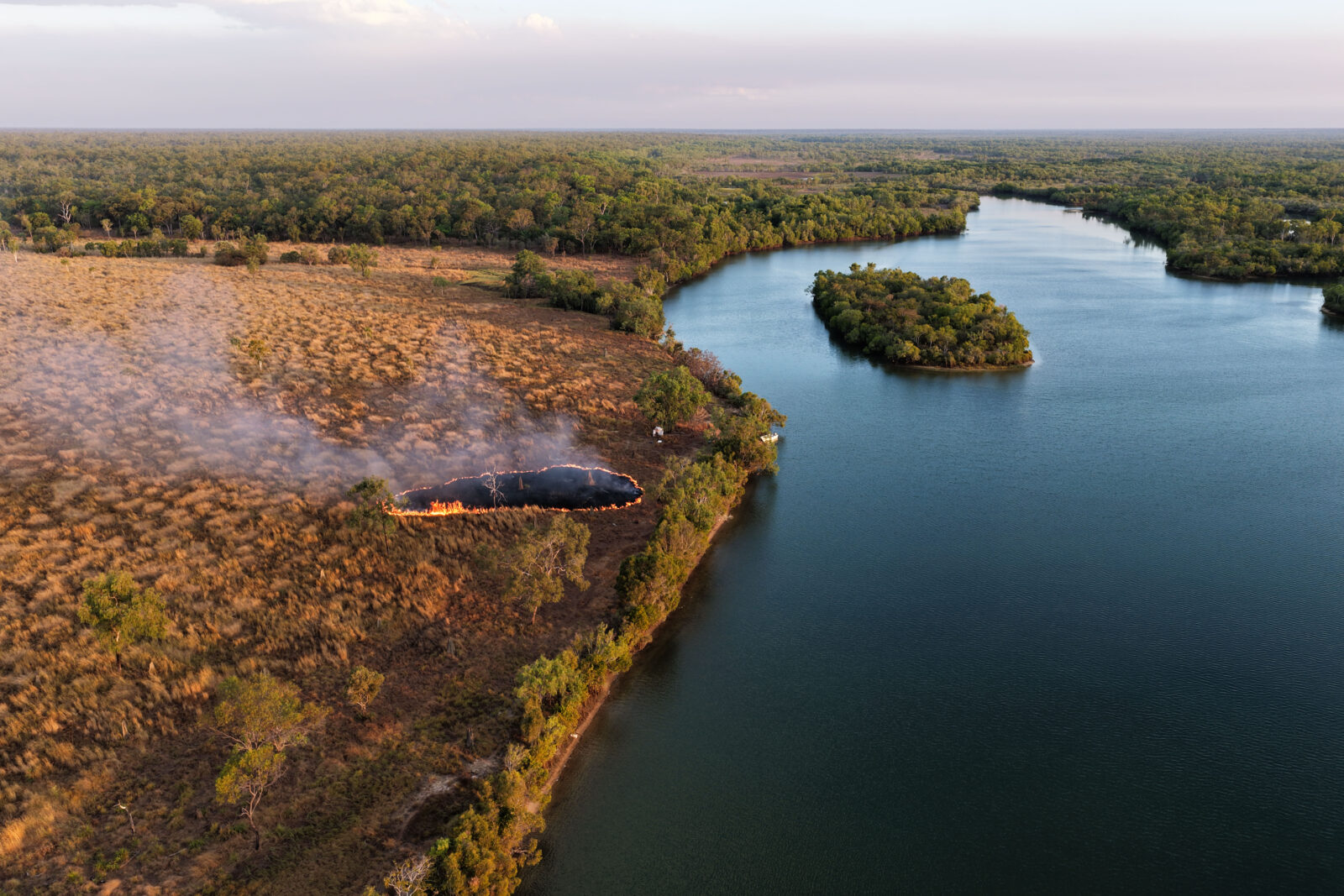
The Archer River and the community of Aurukun are intrinsically linked on the Western Cape York Peninsula in far North Queensland. A vital wetland system of cultural importance, the river, flanked by fig-dominated rainforests, flows into the Gulf of Carpentaria and teems with diverse birds, fish, and wildlife. The lifeblood of the region, this Country is indeed, as Wik-Mungkan Elder Janet Koongotema describes it, ‘a very colourful place’.i
Koongotema not only shows this in the vibrant character of her work but also in its layers, where myriad animals, plants, and stories are embedded, along with totemic figures that first laid them in the landscape. This perception of Country is inherently chromatic and banded, with multiple horizons existing simultaneously in flattened, parallel zones. Koongotema’s Country is so rich that it requires a conceptual plane with many dimensions. The canvas offers Country as structure, territories of colour laid down like the rows of a woven bag.
What kind of seeing produces this image of place? As Jeanie Adams observed of the craftwork in Aurukun during the 1970s and 80s, "the concept of design is not an abstract intellectual concept, but a very down-to-earth practical thing... it is not something that people will describe to you or even explain; it only becomes evident in action."ii
Crucially, Adams noted that two-dimensional design – ground paintings, rock art, bark paintings - "has never been part of the material culture of the peoples of the west coast of Cape York Peninsula."iii When Janet Koongotema paints, she is not continuing a pictorial tradition but translating three-dimensional fibre knowledge into a new medium. From a lifetime of making dilly bags, fishing nets, and pandanus bowls, form is built through horizontal rows of looped fibre.
Koongotema’s paintings operate through two interconnected logics: cartographic mapping, which encodes territorial knowledge into zonal bands, and weaving, which structures the image through the rhythm of textile construction. Both become legible only through active looking.
The impulse to encode territory through horizontal bands has a long history.
In fifth-century Rome, Macrobius Ambrosius Theodosius composed his Commentary on the Dream of Scipio, which included a world map dividing the earth into five climatic zones: frigida septentrionalis and frigida australis (the frozen polar regions), two temperate bands marked habitabilis, and a central perusta or burned zone at the equator. For a thousand years, European scribes copied and adapted this image, stacking horizontal registers to represent what was known, what was habitable, and what remained beyond reach. Despite their geographical content, these Macrobian maps were not intended to provide an up-to-date image of the world, but rather to bridge geography and cosmology, linking the desire to see and map the known world with the desire to explain its position in the cosmological order.
Koongotema's paintings emerge from a different ontology altogether. This Country is not passive terrain but an active field of relationships among people, ancestors, species, and story places. Each location along the Archer River holds a specific Awa – a spiritual centre where totemic beings first shaped the land. Koongotema knows these places intimately, with the authority of a senior custodian: the cold of Aak Chaim, where lilies bloom, and Burdekin ducks gather; the tidal dangers of Moun.aw, where fairies protect sacred ground; the five dilly bag story places she has visited and can name. Each band of colour does not represent distance
from a central point but layers of ecological, spiritual, and ancestral presence. Where medieval cartographers mapped hypothetical zones they would never walk, Koongotema maps Country she has traversed, fished, and sung across eight decades of custodianship.
Where the imagined world of early cartography encodes spatial knowledge into zonal bands, similar to Koongotema's parallel archives of Country, the weaving practices of Aurukun, however, offer a far more direct structural and conceptual key to her paintings. Koongotema belongs to the Winchanam clan, whose totemic identity is bound to the dilly bag itself. "There are five dilly bag stories from my Country," she has said. "They all have their own Awa. I've seen them all."iv
Weaving is not merely a utilitarian act but an expression of ancestral law and clan inheritance, with designs characteristic of the region yet personal to the maker. At least six different fibres can be found in the surrounding bush, depending on the season, giving Wik string bags a variety of textures, colours and strengths. These fine yet sturdy bags – waangk – are constructed without tools, using two upright sticks and a cross string to form a framework. The bag is built row by row, hanging upside down as each horizontal register of loops or knots is added to the last. Knotted bags – waangk onyan – produce visible rows of knots; looped bags – waangk waangkam – create horizontal bands that stretch under weight; twined bags – waangk yoompan – interlace weft rows against a vertical warp. Pandanus coiled basketry (kunchan) unfolds in the same way, spiralling outward from a central ring, each wrapped coil catching up the preceding row, the structure appearing as stacked bands when dyed fibres in golden yellow or brown are incorporated.
Koongotema learned these techniques as a young woman, watching the hands of master weavers like Topsy Warmane. "I was looking at her hands," she recalls. "She said, ‘You sit down and look, watch my hand’. I obeyed her."v What those hands taught was a way of building form through horizontal accumulation, and when she paints, the brush moves as the fibre once did: lateral passes from the bottom upwards, each band laid against the last. The structural logic of her clan's totem has migrated to the canvas, not as representation but as method.
Janet Koongotema employs two ways of knowing in her contemporary painting practice: the conceptual and the tactile, the mapped and the woven. Her paintings encode Country as territory, layered with story places, active with ancestral presence, and rich with cultural and ecological knowledge. Yet they also embody the practical, utilitarian skill and logic of a past practice: the physical memory of fibre passing through fingers, row building upon row, form emerging through a lateral composition. Koongotema not only depicts Country; she constructs it, using the same structural order that has shaped the woven objects, made and shared between clans of the Aurukun region.
Today, Koongotema is the sole living practitioner of traditional Wik-Mungkan weaving techniques in Aurukun. Although she transitioned to painting in 2010, her paintings still hold and carry this knowledge forward. "We send these paintings away so people can see my Country," she has said. "This Country belongs to Wik-Mungkan people like me. We are from the Winchanam Clan."vi
In Koongotema’s hands, the canvas becomes a bridge for viewing both the micro and macro elements of the Archer River. Each band of colour is an invitation to see as she sees, not through explanation, but through the patient accumulation of looking.
VANESSA MERLINO
REFERENCES
- Adams, Jeanie, Crafts from Aurukun: design for a local environment, Aurukun Community Incorporated, 1986. Facsimile edition 2013 by Cape York Aboriginal Australian Academy, Cape York Institute for Policy and Leadership.
- Hiatt, Alfred, 'The Map of Macrobius before 1100', Imago Mundi, vol. 59, no. 2, 2007, pp. 149–176.
- Koongotema, Janet, artist statement, Wik & Kugu Art Centre documentation, Aurukun.
- Sutton, Peter, 'Art and Aurukun Cultural History', in Sally Butler (ed.), Before Time Today: Reinventing Tradition in Aurukun Aboriginal Art, University of Queensland Press, St Lucia, 2010, pp. 33–55.
- Burnett, David, 'Art of the Cape: An Introduction', in Story Place: Indigenous Art of Cape York and the Rainforest, Queensland Art Gallery, Brisbane, 2003, pp. 20–31.
- i Janet Koongotema, quoted in D’Lan Contemporary, artist biography, 2024.
- ii Jeanie Adams, Crafts from Aurukun: design for a local environment, Aurukun Community, 1986, p.
- iii Adams, Crafts from Aurukun, p. 3.
- iv Janet Koongotema, in conversation with Wik & Kugu Art Centre, Aurukun.
- v Janet Koongotema, in conversation with Wik & Kugu Art Centre, Aurukun.
- vi Janet Koongotema, in conversation with Wik & Kugu Art Centre, Aurukun.
Continue reading +
Koongotema not only depicts Country; she constructs it, using the same structural order that has shaped the woven objects, made and shared between clans of the Aurukun region.
VANESSA MERLINO
Installation Views
Fullscreen